
WHAT I SHARED AT THE BLADDER HEALTH UK CONFERENCE: WHY SUPPORTING YOUR BLADDER LINING MATTERS MORE THAN AVOIDING "ACIDIC FOODS"

How to Support the Bladder Lining Naturally
If you've spent any time searching online for bladder health advice, you've probably come across long lists of foods to avoid.
Tomatoes. Citrus. Coffee. Vinegar. Spices.
For many women living with interstitial cystitis, bladder pain, or persistent urinary symptoms, these lists can become longer and longer over time until they're left wondering what they're actually allowed to eat.
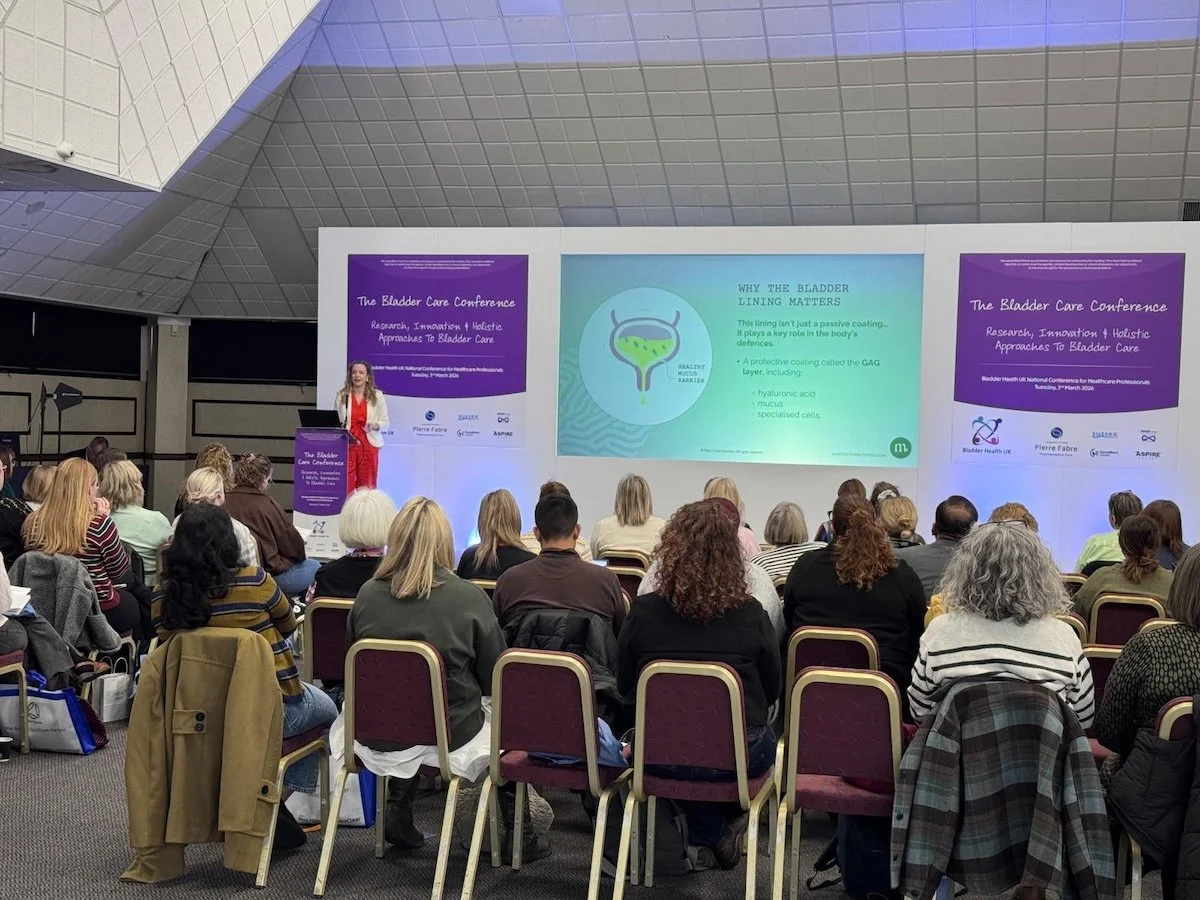
Earlier this year, I had the opportunity to speak at the Bladder Health UK Conference about a topic that I believe deserves far more attention: the bladder lining and how nutrition may help support its resilience.
My message was simple:
Supporting the bladder lining may be far more important than obsessing over whether a food is "acidic". When we focus solely on restriction, we miss the bigger picture.
THE MISSING PIECE IN MANY BLADDER CONVERSATIONS
When people think about bladder flares, they understandably think about infection.
And while infection certainly matters, there is another important piece of the puzzle: the health of the bladder lining itself.
Inside the bladder sits a thin protective barrier, sometimes referred to as the GAG layer. This layer is made up of specialised cells, mucus and protective compounds that help shield the delicate tissues underneath.
Far from being a passive coating, this barrier plays an active role in our body's defence system.
A healthy bladder lining helps:
Act as a physical barrier against irritants
House beneficial bacteria (which help protect us from infection)
Prevent harmful bacteria from attaching to the bladder wall
Regulate what passes through to the underlying tissues
Support immune activity within the bladder
Think of it like a well-maintained castle wall. When that wall is strong, it helps keep unwanted visitors out. But when it becomes damaged or weakened - perhaps through recurring infections, repeated antibiotic exposure, or microtrauma associated with procedures such as catheters, bladder instillations or Botox injections - the bladder may become more vulnerable to irritation, inflammation and infection.
WHY THE BLADDER LINING CAN BECOME COMPROMISED
For many of the women I work with, bladder symptoms haven't appeared out of nowhere.
There has often been a long history of recurring urinary tract infections, repeated antibiotic courses, medical procedures, hormonal changes, stress, dietary restriction, alcohol, or ongoing inflammation.
Over time, these factors may affect the protective environment within the bladder.
When the mucus layer becomes compromised, harmful bacteria may have greater opportunity to come into contact with the cells underneath, driving inflammation. At the same time, the beneficial bacteria that help regulate the environment and reduce our risk of UTIs may struggle to thrive.
This may help explain why some people continue to experience symptoms even after an infection has been treated.
The infection may have resolved, but the tissues and environment still need support.
THE PROBLEM WITH FOCUSING ONLY ON FOOD RESTRICTIONS FOR IC AND UTIs
One of the biggest challenges I see clinically is that many women have become trapped in a cycle of restriction. They've been told to avoid more and more foods in an attempt to manage their symptoms.
Over time, they may cut out citrus, tomatoes, vinegars, gluten, dairy, spicy foods, chocolate and countless other foods.
The result?
Often a smaller diet, increased food anxiety, reduced dietary diversity and, in some cases, poorer nutrition overall. This is where I believe we need a different conversation. When we talk about nutrition for bladder health, we need to think in two directions:
1) Risk reduction
Reducing factors that may aggravate symptoms or increase inflammatory load, such as:
Excess caffeine
Excess alcohol
High sodium intake
Diets dominated by ultra-processed foods
2) Restoration
Actively providing the nutrients and compounds that help support repair, resilience and recovery.
Because removing what harms is only half the story. We also need to supply what protects. This is where a Mediterranean-style dietary pattern can be incredibly helpful.

THE MEDITERRANEAN DIET: A PRACTICAL FRAMEWORK FOR BLADDER HEALTH
Rather than focusing on endless lists of foods to avoid, I often use a Mediterranean-style dietary pattern as a practical framework. This way of eating naturally provides many of the nutrients involved in immune resilience, microbial diversity and tissue repair. Interestingly, greater adherence to a Mediterranean dietary pattern has also been associated with a reduced risk of bladder cancer in several studies, suggesting that what we eat may influence bladder health at the level of the bladder tissue itself.
This approach naturally provides many of the nutrients involved in:
Immune resilience
Epithelial repair
Microbiome support
Inflammation regulation
Metabolic stability
In practice, that means prioritising:
Adequate protein
Colourful plant foods
Healthy fats such as extra virgin olive oil
Fibre-rich foods
Prebiotic and probiotic foods
Zinc-rich foods
Vitamins A and D
Instead of asking, "What should I cut out?"
We begin asking:
"What can I add that helps my body repair and protect itself?"
HOW TO SUPPORT THE BLADDER LINING NATURALLY?
When we think about supporting the bladder lining, it's helpful to think beyond what to remove and focus on what helps the body repair and protect itself from UTIs and flare ups.
One of the most important foundations is adequate protein. The bladder lining is living tissue and, like skin or muscle, it relies on amino acids to repair and regenerate. Without sufficient protein, the body simply doesn't have the raw materials it needs for repair.
Alongside protein, colourful plant foods provide polyphenols - natural compounds that support microbial balance and help regulate inflammation. While cranberry PACs (not cranberry juice!) are well known for their role in urinary health, berries, red cabbage, apples, herbs, spices and extra virgin olive oil all contribute beneficial compounds that support the wider environment in which healing takes place.
I also discussed mucilage-rich foods at the conference. These foods, including chia seeds, okra, aloe vera and seaweed, contain gel-forming fibres that help support mucosal surfaces and beneficial bacteria. Most research has focused on gut health, but because both the gut and bladder rely on protective mucosal barriers, these foods may offer valuable support as part of a broader bladder health strategy.
Another important consideration is the bladder microbiome. We now know the bladder is home to its own community of beneficial bacteria that help regulate the local environment, compete with unwanted microbes and support immune function. This is one reason dietary diversity matters so much. Beneficial bacteria don't simply arrive and stay forever - they need nourishment too.
I often explain this to clients using a simple analogy. Probiotics bring the guests to the party. Prebiotic foods provide the nibbles. If nobody gets fed, the guests won't stay for very long. The same is true for beneficial bacteria. They thrive when we provide the fibre, polyphenols and plant diversity that help them flourish.
Finally, several nutrients play important roles in barrier integrity and immune resilience, including zinc, vitamin A and vitamin D. Vitamin D is particularly interesting because receptors for vitamin D are found within the urinary tract itself, highlighting its potential role in supporting bladder health.
RESTRICTION MANAGES SYMPTOMS. RESILIENCE BUILDS BARRIER STRENGTH.
If there was one message I hoped healthcare professionals would take away from my talk, it was this:
The goal isn't endless restriction. It's resilience.
Yes, there may be times when certain foods aggravate symptoms but long-term healing is rarely built on taking more and more foods away. It's built by nourishing the systems that protect us:
The bladder lining.
The microbiome.
The immune system.
The body's ability to repair and recover.
Because your bladder lining, like any other tissue in the body, needs nourishment to heal and supporting that process may be one of the most overlooked pieces of long-term bladder health.
The good news is that supporting your bladder lining doesn't need to be complicated. Small, consistent changes to how you nourish your body can have a meaningful impact over time.
Because so many women ask me where to start, I created a short course called Chronic UTIs: The Root Cause Reset. Inside, I guide you through the same food-first, Mediterranean-style framework I use with clients, along with evidence-based supplement strategies that support the bladder lining, microbiome, immune system and long-term urinary health.
If you're tired of cutting out more foods, worrying about every meal, and want a clear, practical roadmap to support your bladder health alongside medical care, you can learn more about the course here.
After all, the goal isn't endless restriction. It's resilience.
